
Rank tracking for roofers
Google Maps Rank Tracking for Roofing Companies
Roofers cover big areas and win big jobs, so a gap in visibility on one side of the metro can cost a lot of work. GridBeacon checks your Google Maps ranking from every point of a wide grid, for repair, replacement and storm work, and shows which roofers take those searches where you don't.
No credit card required. New accounts get 500 free scan credits.
- Usually a service-area business
- Metro-wide grids
- Up to a 100-mile radius
How customers search
The Searches That Bring Roofers Jobs
Roofing searches split between urgent repairs and planned replacements, with storm-related searches spiking after bad weather.
| Search | Why track it | What it tells you |
|---|---|---|
| roofing contractor / roofer | The general searches, both worth tracking. | Your overall reach across the metro. |
| roof repair | Frequent, often urgent work. | Whether you win the calls after a leak appears. |
| roof replacement | The highest-value jobs. | Visibility where the big contracts come from. |
| storm damage roof repair | Demand that surges after storms. | Whether you're found when demand spikes. |
| metal roofing | A specialist material some roofers focus on. | An opportunity if you offer it. |
| commercial roofing | A different customer and set of competitors. | Reach for commercial work, if you do it. |
Setting up tracking
How to Set Up Rank Tracking for a Roofing Company
Most roofers work across a metro area or region and hide their address. Use a large grid to see how far your visibility reaches and where it drops.
Centre
Where Google places your listing, looked up from its Maps link.
Grid
13 × 13 or larger for a metro.
Radius
10–25 miles, or more in rural regions.
Schedule
Monthly, plus an extra scan after major storms.
Budget: 5 keywords on a 13 × 13 grid scanned monthly is 845 credits; scanned weekly, about 3,660, inside the Starter plan's 8,000.
Example scan
Reading a Geo-Grid Scan: What Roofers Should Look For
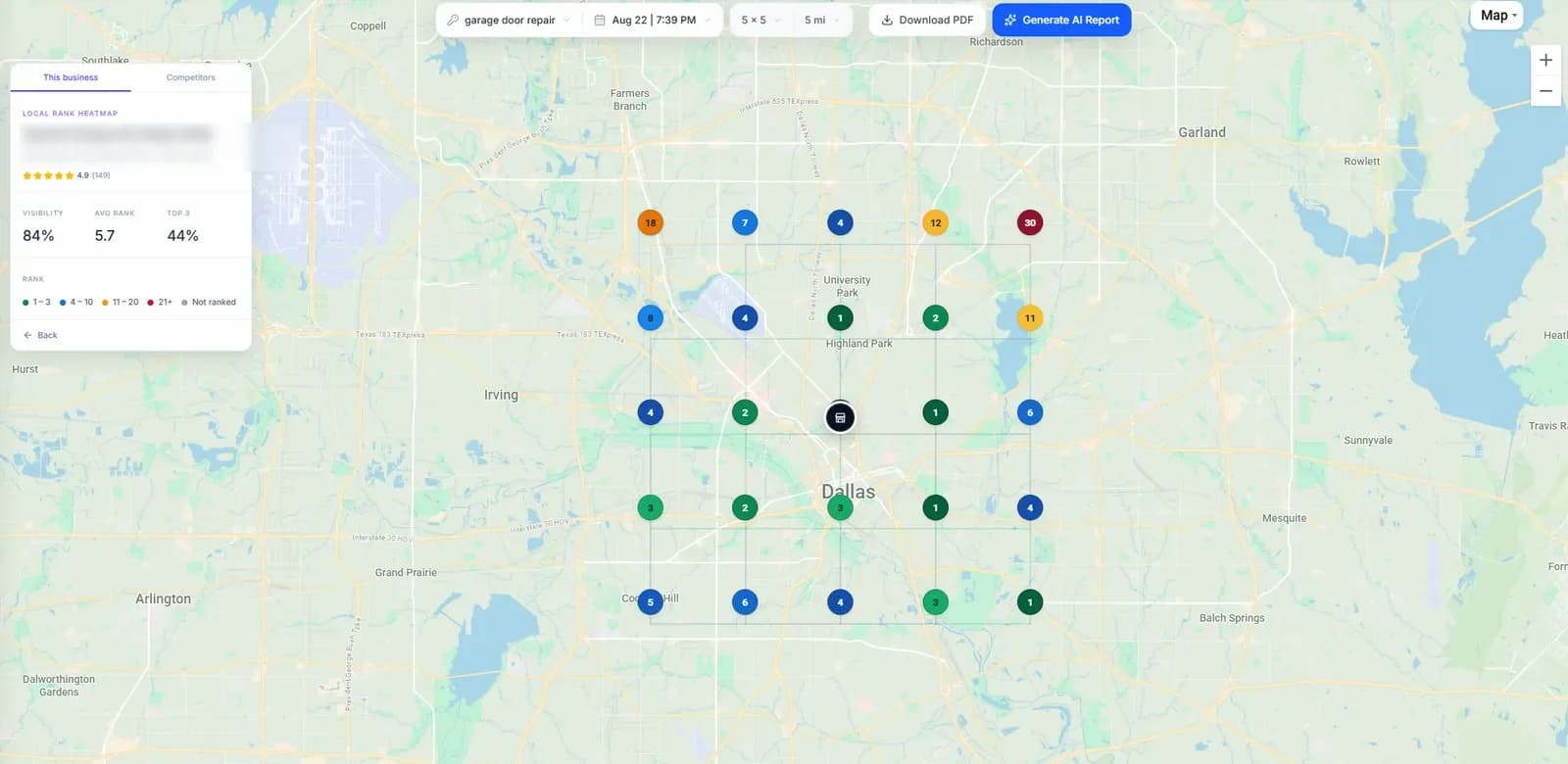
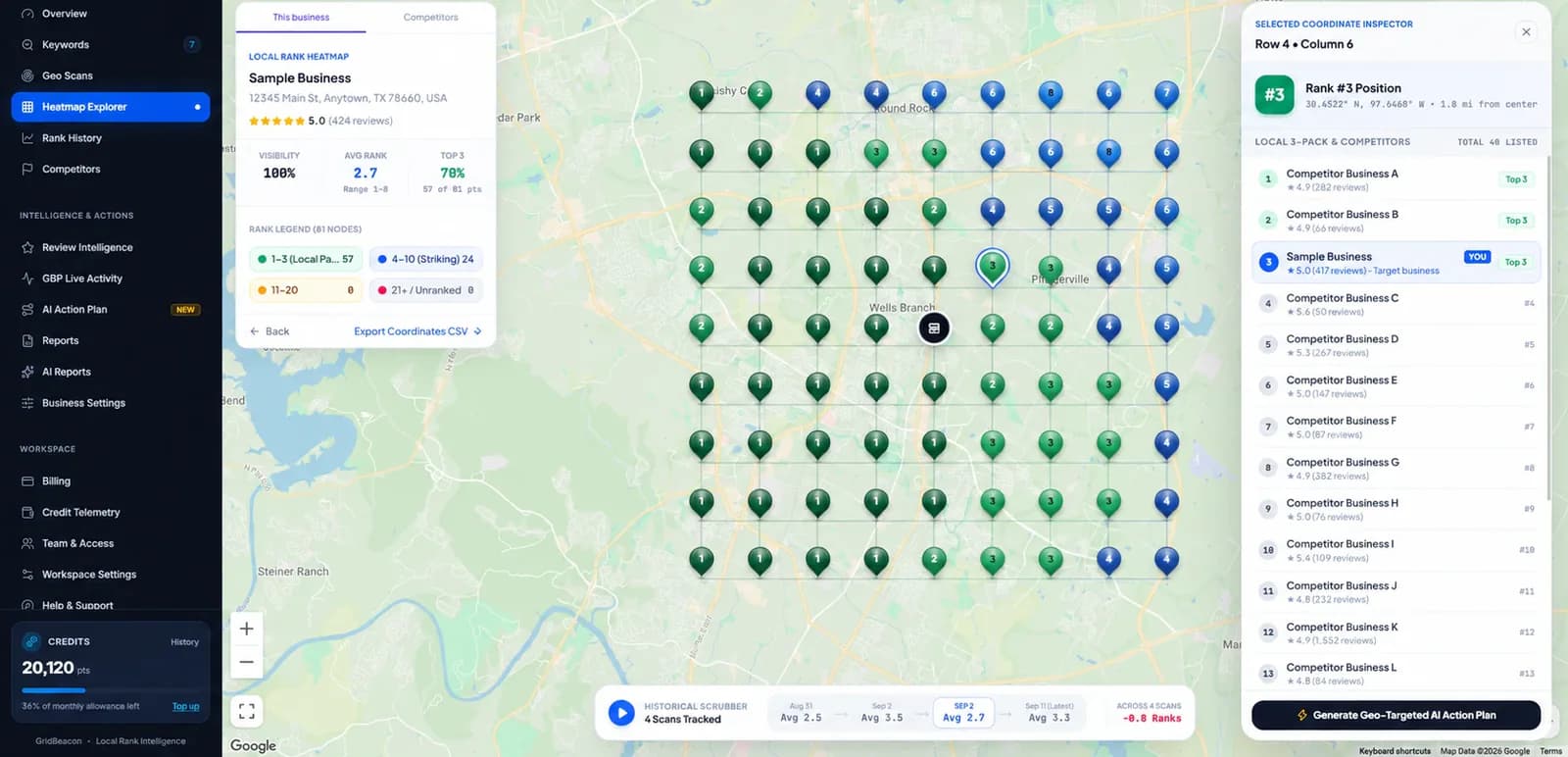
The screenshots are real GridBeacon scans of other businesses, shown as examples. When you scan your own business, look for these:
- Where the green stops: the edge of the area where customers see you in the top three.
- Which direction fades fastest: often where a strong competitor is based.
- Who holds the points you lose: select a point to see every business ranked there.
- Whether each keyword tells the same story: run the searches in the table above separately.
Run the same scan again in a week or a month, with the same centre, grid and radius, and the trend arrows show what moved.
The competition
Who Roofers Compete With on Google Maps
A roofing map pack across a metro usually includes:
Established local roofers
Long-standing companies with deep review histories in their home area.
Contractors from other towns
Roofers who arrive after major storms and push for visibility while demand is high.
General contractors
Builders and remodelers who list roofing among many services.
Local Services Ads
Google's ads above the map pack for roofing searches, which take clicks without changing map rank.
Material specialists
Metal, tile or flat-roof specialists who can lead their niche.
Lead-generation listings
Listings that pass jobs on to other roofers. Check any unfamiliar name holding large areas.
Storm season
Tracking Roofing Rankings Around Storm Season
Storms change who is searching and who is competing. Use scans to see it happen:
Before the season
Scan your full keyword set so you have a baseline to compare against.
After a major storm
Run an extra scan for repair and storm-damage keywords to see who gained ground.
Watch new names
Biggest Competitor Changes shows businesses that climbed quickly.
Afterwards
Compare with the baseline to see what held and what faded.
Diagnosis
Common Google Maps Ranking Problems for Roofers
What a geo-grid usually shows when something is wrong, and where to look first. These are starting points, not guarantees.
| What the grid shows | Common cause | Where to look first |
|---|---|---|
| Visible in the home suburb, not across the metro | Distance from where Google places the listing | Prominence: reviews across the area, local links, project content |
| Repair ranks, replacement doesn't | The profile signals small jobs more than big ones | Replacement services, project photos and pages |
| A new name suddenly takes large areas | A contractor pushing hard after a storm | Biggest Competitor Changes and their review pace |
| Grid is nearly empty | Grid centred on the city rather than the listing | Centre on the listing's location |
| Paying for points in lakes or farmland | A wide radius over empty ground | Exclude those points; excluded points use no credits |
FAQ
Rank Tracking for Roofers: Questions
How do roofers track Google Maps rankings across a whole metro?
With a large geo-grid, such as 13 × 13 over a 10–25 mile radius, centred where Google places the listing. It shows exactly where your visibility reaches and where competitors take over.
How often should a roofing company scan?
Monthly is usually enough, plus an extra scan after major storms when demand and competition change quickly.
Why do we rank for roof repair but not roof replacement?
Google matches searches to what your profile and site show. If most of it is about repairs, replacement searches may favour roofers who show more replacement work.
Is a big grid expensive?
A 13 × 13 grid is 169 credits per keyword. Five keywords monthly is 845 credits, and excluding points over water or empty land lowers it further.
Do storm chasers affect our map rankings?
Contractors who move in after storms add competition for a while. A scan after the storm shows who gained ground and where.
See How Far Your Roofing Visibility Reaches
Scan your metro on a large grid with 500 free credits.
No credit card required.