
Rank tracking for pest control
Google Maps Rank Tracking for Pest Control Companies
Pest control customers search for the pest in front of them, and national chains have a branch in almost every town. GridBeacon tracks where your company ranks on Google Maps for each pest and service across your area, so you can see where you beat the chains and where they win.
No credit card required. New accounts get 500 free scan credits.
- Usually a service-area business
- Pest-by-pest keywords
- Seasonal tracking
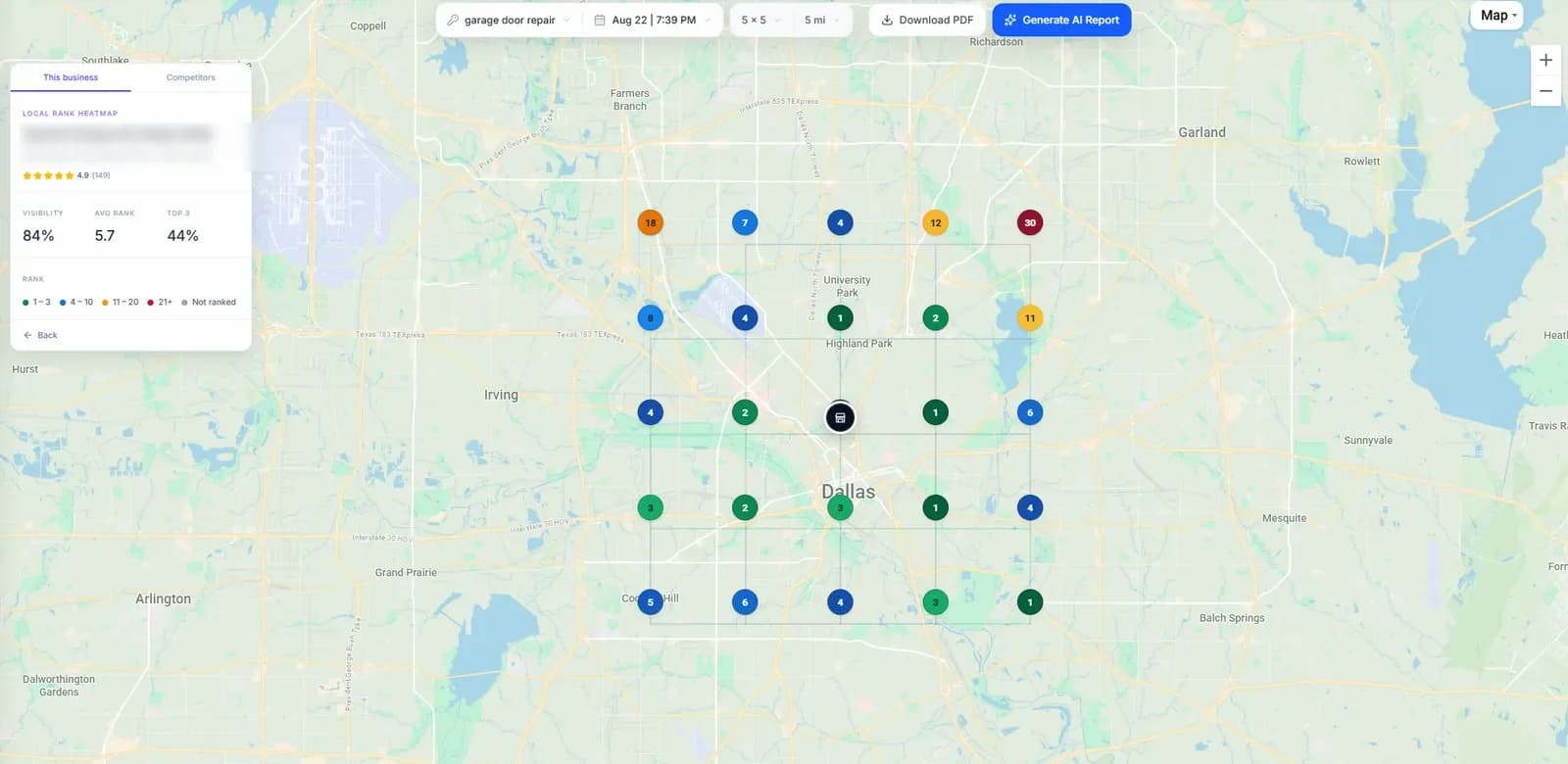
How customers search
The Searches That Bring Pest Control Customers
People search for the pest, the service or the trade, and “exterminator” and “pest control” can return different map packs.
| Search | Why track it | What it tells you |
|---|---|---|
| pest control | The general search. | Your overall reach across the area. |
| exterminator | A common alternative wording. | Whether the other wording ranks you differently. |
| termite inspection / treatment | High-value work, often tied to property sales. | Visibility for your most valuable service. |
| bed bug treatment | Urgent and specialised. | Whether you win a high-stress, high-value search. |
| rodent control | Common, year-round work. | Reach for routine callouts. |
| mosquito control | Seasonal, often recurring treatments. | Visibility when the season starts. |
Setting up tracking
How to Set Up Rank Tracking for a Pest Control Company
Pest control technicians work at the customer's property and often cover wide areas, so set the business up as a service-area business.
Centre
Where Google places your listing, looked up from its Maps link.
Grid
9 × 9 to 13 × 13 across your service area.
Radius
8–15 miles for a city and its suburbs.
Schedule
Weekly as seasonal pests appear, monthly otherwise.
Budget: 6 keywords on a 9 × 9 grid scanned weekly is about 2,100 credits a month, inside the Starter plan's 8,000.
Example scan
Reading a Geo-Grid Scan: What Pest Control Companies Should Look For
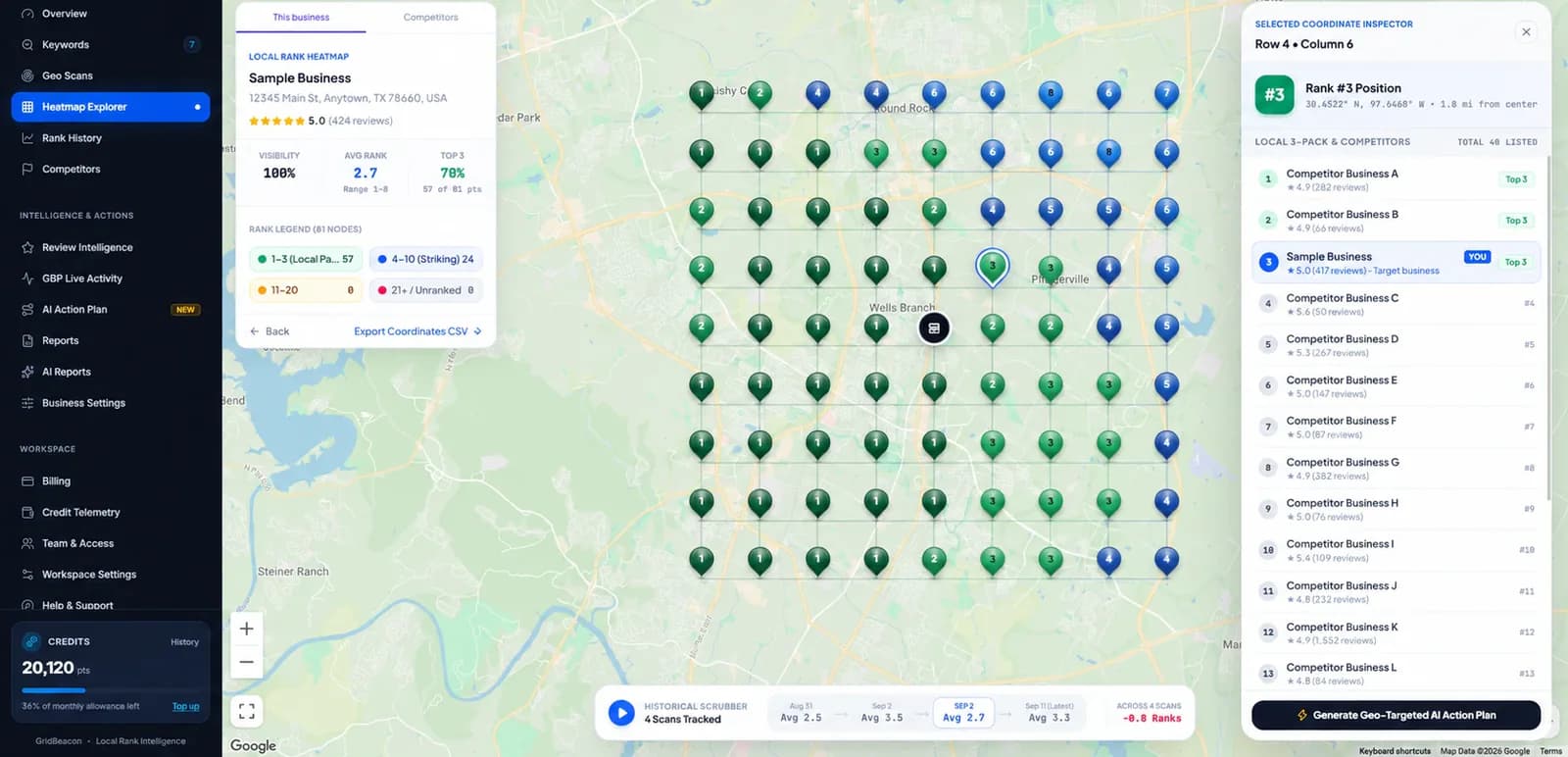
The screenshots are real GridBeacon scans of other businesses, shown as examples. When you scan your own business, look for these:
- Where the green stops: the edge of the area where customers see you in the top three.
- Which direction fades fastest: often where a strong competitor is based.
- Who holds the points you lose: select a point to see every business ranked there.
- Whether each keyword tells the same story: run the searches in the table above separately.
Run the same scan again in a week or a month, with the same centre, grid and radius, and the trend arrows show what moved.
The competition
Who Pest Control Companies Compete With on Google Maps
In most pest control grids you'll find:
National chains
Large brands with a local branch listing in most areas and big review counts.
Regional companies
Multi-branch firms that dominate a state or region.
Pest specialists
Termite, bed bug or wildlife specialists that lead their niche.
Lawn and mosquito services
Businesses competing for seasonal outdoor treatments.
Local Services Ads
Google's ads above the map pack for pest control searches, which take clicks without changing map rank.
Neighbouring towns
Companies whose listing sits nearer to part of your grid.
Seasonality
Tracking Pest Control Rankings Through the Year
Different pests peak at different times. Match your scanning to the season:
Spring
Scan termite, ant and general keywords weekly as activity starts.
Summer
Add mosquito and stinging-insect keywords to the weekly set.
Autumn and winter
Rodent searches rise as pests move indoors.
All year
Keep bed bug and general keywords on a monthly scan.
Diagnosis
Common Google Maps Ranking Problems for Pest Control Companies
What a geo-grid usually shows when something is wrong, and where to look first. These are starting points, not guarantees.
| What the grid shows | Common cause | Where to look first |
|---|---|---|
| A national chain wins most of the grid | Prominence: review volume and brand strength | Where you do win; review pace; the pests the chain doesn't focus on |
| “Pest control” ranks, “exterminator” doesn't | Different wording, different map pack | Use both terms naturally across the profile and site |
| Weak for one pest | The profile doesn't signal that service | Services list, photos and a page for that pest |
| Visible near the listing only | Distance from where Google places the listing | Reviews and local links to extend reach |
| Seasonal rankings slip each year | Competitors more active when the season starts | Scanning and profile activity ahead of the season |
FAQ
Rank Tracking for Pest Control Companies: Questions
How can a local pest control company compete with national chains on Google Maps?
A geo-grid shows exactly where the chains win and where you do. Many independents lead near their base and for specific pests; the grid shows where to focus.
Should I track “exterminator” and “pest control” separately?
Yes. They can return different map packs, and customers use both.
Which pest keywords are worth tracking?
The services that bring the most revenue, such as termite treatment or bed bugs, plus the seasonal pests common in your area.
What grid size suits a pest control company?
9 × 9 to 13 × 13 with an 8–15 mile radius, centred where Google places your listing.
How often should pest control rankings be scanned?
Weekly for the pests in season, monthly for the rest.
See Where You Beat the Chains
Scan your pest control keywords across your area with 500 free credits.
No credit card required.